



 Export PDF
SUMMARY
Operational leadership depends on understanding how work actually unfolds across the organization. In many companies this visibility relies on fragmented updates, manual check-ins, or scattered dashboards that fail to show the full picture. Kaamfu addresses this problem through structured reporting that converts operational activity into clear leadership insight. Admin members and organization owners can generate and schedule reports that provide consistent visibility into how work moves across the workspace.
IN BRIEF
-
Leadership visibility gap – Managers often rely on fragmented updates instead of structured insight into how work effort and activity are distributed.
-
Manual update culture – Status meetings, check-ins, and dashboards attempt to replace reliable operational reporting.
-
Updates lack structure – Individual updates rarely reveal how work moves across teams, time, and operational layers.
-
Structured reporting shift – The Reports Panel enables leadership to generate and schedule structured reports summarizing real operational activity.
-
Kaamfu operational clarity – Kaamfu converts workspace activity into leadership reports that provide controlled and consistent operational visibility.
Leadership visibility often depends on updates that arrive through meetings, messages, and scattered dashboards. Managers ask for status reports, teams share progress updates, and leadership tries to assemble an operational picture from fragments of information. These updates create the appearance of transparency, but they rarely provide a structured understanding of how work actually unfolds across the organization.
The problem becomes more severe as organizations scale. Work activity spreads across multiple teams, boards, and operational layers, while leadership continues receiving isolated updates that describe only small portions of the system. Instead of understanding operational patterns, managers spend time collecting updates from different sources.
The issue is not the lack of information. Work platforms generate large amounts of operational data every day. The real challenge is transforming that activity into structured reports that leadership can interpret consistently. Kaamfu addresses this challenge through the Reports Panel, which converts operational signals into clear reporting that leaders can review or schedule automatically.
Why Leadership Reporting Breaks in Many Work Systems
Many operational platforms generate dashboards and analytics views that display activity metrics. These dashboards can show logs, counts, and charts, yet they still require leaders to interpret what those signals actually mean. Managers often switch between dashboards or ask teams to explain the context behind the numbers.
As a result, leadership oversight becomes dependent on updates instead of structured reporting. Status meetings, message threads, and manual summaries attempt to fill the gap left by incomplete reporting systems. These updates provide momentary insight but rarely reveal how work activity is distributed across the organization.
The challenge grows as operational complexity increases. Additional teams and workspaces generate more activity signals, which makes manual interpretation increasingly difficult. Without structured reporting, leadership spends more time gathering updates than understanding operational patterns.
Kaamfu addresses this issue by transforming workspace activity into structured reports designed for leadership interpretation rather than leaving leaders to assemble insight from scattered updates.
What the Reports Panel in Kaamfu Provides
Leadership visibility improves when operational activity is translated into structured summaries rather than scattered updates. The Reports Panel consolidates key reports in one location and converts activity signals into reporting that leadership can review consistently.
Each report focuses on a specific dimension of organizational activity, allowing leadership to understand how time, responsiveness, and effort are distributed across the workspace.
The panel includes several core reports that summarize operational signals.
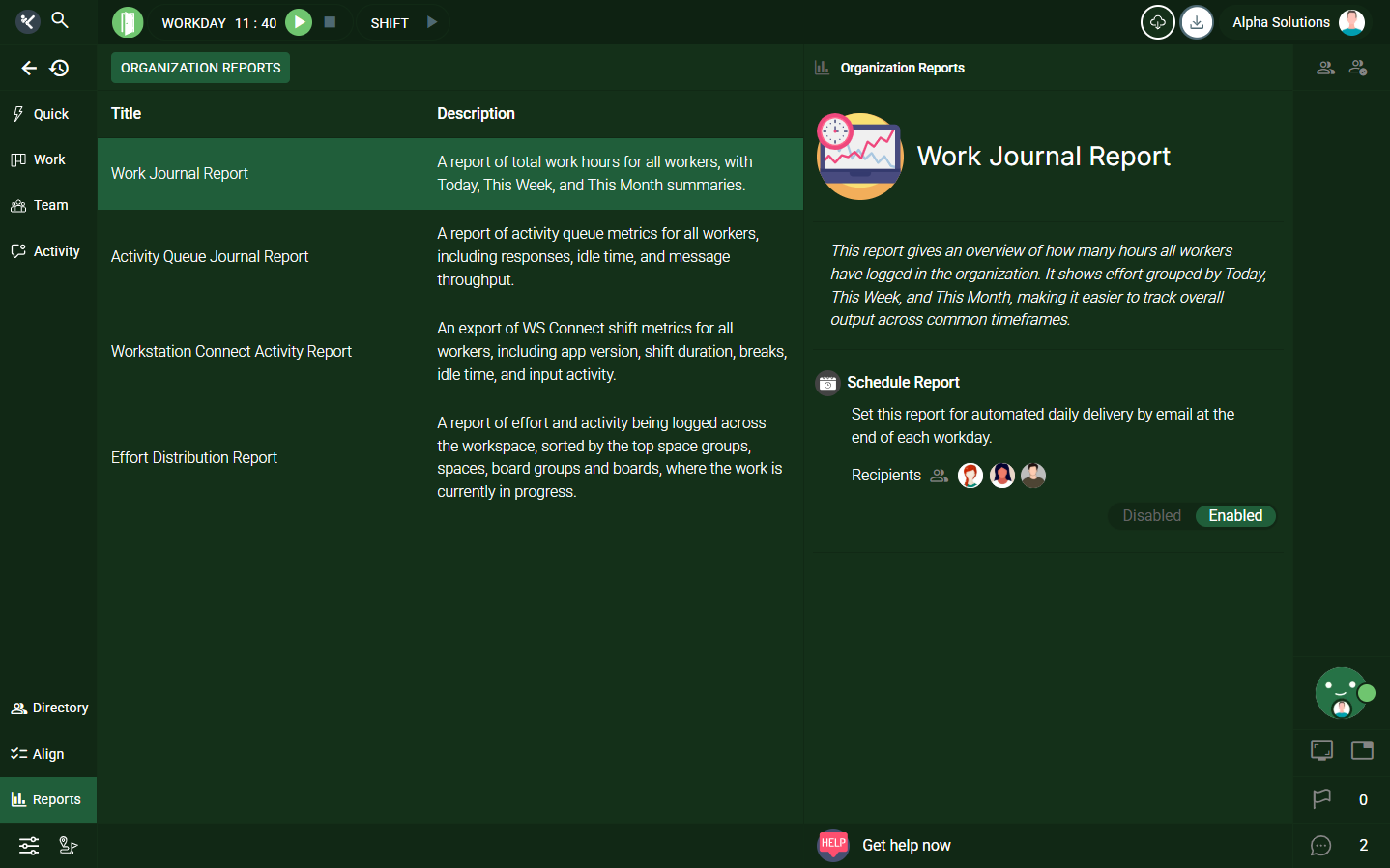
• Work Journal Report – Summarizes total work hours across the organization and groups them by Today, This Week, and This Month.
• Activity Queue Journal Report – Displays responsiveness and communication metrics such as response times, idle periods, and message throughput.
• Workstation Connect Activity Report – Shows shift duration, break periods, idle intervals, and input activity from workers using Workstation Connect.
• Effort Distribution Report – Maps how work effort is distributed across space groups, spaces, board groups, and boards.
These reports convert daily operational activity into structured summaries that leadership can review without gathering updates from multiple teams or dashboards. Managers receive a consolidated view of how work activity unfolds across the organization, which allows them to focus on interpreting operational signals rather than collecting them.
Scheduling Reports for Leadership
Reliable reporting requires consistency. When reporting depends on manual exports or occasional report generation, leadership visibility becomes irregular and unreliable. Managers may receive updates only when someone prepares a report or remembers to export operational data.
The Schedule Report feature in the Reports Panel removes this dependency by allowing administrators to automate report delivery. Admin-level members and the organization owner can configure reports to be generated and delivered at the end of each workday. Once the schedule is enabled, Kaamfu automatically produces the report and sends it to the selected recipients.
This scheduling mechanism creates a predictable reporting rhythm. Instead of requesting updates from teams or generating reports manually, leadership receives structured insight into operational activity at consistent intervals. Managers can then interpret these signals and identify patterns without interrupting teams for status updates.
Leadership Control Over Report Delivery
Reporting in Kaamfu is designed to remain under leadership control rather than automatically flooding managers with reports. Leaders decide which reports should be enabled and who should receive them, which ensures reporting remains relevant to the organization’s operational needs.
Certain operational milestones determine when reporting becomes meaningful. When a new organization signs up but has not invited team members or started the workday, the reporting system remains inactive because there is no operational activity to summarize. Reports remain disabled until the workspace begins functioning as an active work environment.
Once the workday is activated and workers begin shifting in, operational signals become measurable and reporting becomes useful. At that point reports can be enabled and scheduled according to leadership preferences. This approach ensures that reporting reflects real operational activity rather than generating unnecessary updates before work actually begins.
Why Report Access Is Limited to Admins and the Org Owner
Organizational reports summarize activity across teams, boards, and operational layers. These summaries provide leadership with insight into how effort, time, and responsiveness are distributed across the workspace, which makes them relevant primarily to management roles responsible for oversight.
For this reason, Kaamfu restricts access to the Reports Panel to admin-level members and the organization owner. Leadership can review operational patterns and reporting signals while workers remain focused on execution inside boards, tasks, and conversations.
This separation preserves clarity across the workspace. Teams concentrate on executing work, while leadership interacts with the reporting layer that summarizes how work activity unfolds across the organization.