



 Export PDF
SUMMARY
Kanban boards show what is moving. They do not show why decisions were made, what changed mid-project, or what the person before you was thinking when they moved that card. Work stalls when context is lost, decisions go unrecorded, and conversations pile up in tools that have no connection to the task they belong to. Kaamfu’s Work Panel organizes work into three levels, Spaces, Boards, and Items, each carrying its own embedded chat and notes, so communication stays attached to the work where it belongs.
IN BRIEF
- Kanban is standard – Every major work management platform organizes tasks in boards and cards, so the layout alone no longer separates any product from the rest.
- Context lives elsewhere – When chat and notes sit outside the work object, the decisions made in conversation are never tied to the task they belong to.
- Three problems follow – Context gets lost at handoff, decisions go unrecorded at the work level, and the same conversation gets duplicated across tools that cannot consolidate it.
- Embedded context closes the gap – Kaamfu’s Work Panel attaches chat and notes directly to every object at every level of the work hierarchy.
- Kaamfu changes the architecture – Kaamfu is the work management platform built for the race to autonomy, giving organizations the infrastructure to keep communication and work unified in one place.
Work management tools have a visibility problem. Every platform shows you what is in progress and what is stuck. What none of them show you is why any of it ended up that way.
Fixing that requires a structural change to where communication lives relative to the work. A better board layout or a smarter notification system leaves the gap in place. When the conversation about a task is embedded in the task itself, context stops being something teams have to maintain manually and starts being something the platform carries automatically.
The Problem That Has Been Killing Collaboration Tools Since 2009
Google launched Wave in 2009 as an ambitious attempt to unify communication and work in one place. It shut down less than two years later. Post-mortems from analysts at the time named the same root cause repeatedly: no context. Communication existed as its own layer, detached from the actual work it was supposed to support, and users had no clear way to tie a conversation to the project or task it belonged to.
Google tried again with Currents in 2019, a collaboration layer for enterprise Workspace users. It was shut down in July 2023 for the same structural reason: communication that lives alongside work, rather than inside it, always breaks down. The pattern across both products is the same one that plays out inside organizations using kanban tools today, where the board holds the status and the chat tool holds the reasoning, with nothing connecting the two.
Three Levels, One Unified Work Record
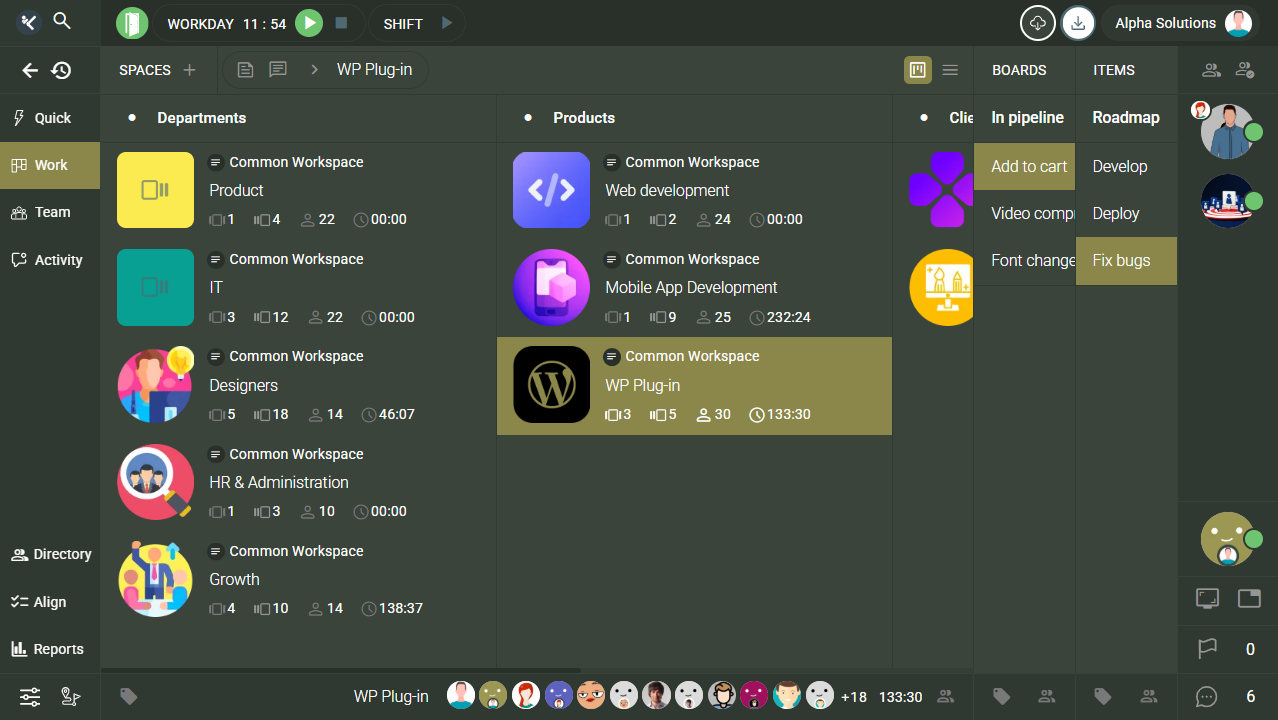
Kaamfu’s Work Panel organizes all work into three levels: Spaces for workstreams, Boards for projects within those workstreams, and Items for the tasks within each project. Every level uses the kanban layout teams already know, and every object at every level carries its own embedded chat and notes so the work and the conversation about it always live in the same place:
- Space – The workstream container: A department, function, or operational area. Embedded chat at the Space level captures decisions that affect the workstream as a whole: resourcing calls, scope boundaries between projects, and directional changes that affect everything running underneath.
- Board – The project within a workstream, organized in kanban columns: Embedded chat at the Board level holds the project record: why timelines shifted, what stakeholders requested, what was descoped and on whose authority.
- Item – The task within a project: Embedded chat and notes at the Item level mean the person picking up a task reads the full conversation history before touching it. No reconstruction. No asking questions that were already answered.
The hierarchy builds on how teams already work. It adds a structural layer on top of a familiar format that fills the context gap kanban alone has always had.
How context is handled: most platforms versus Kaamfu
Context problems follow predictable patterns. The table below maps four of the most common ones against how each plays out on a standard kanban platform versus inside Kaamfu’s Work Panel.
| Situation | Other kanban platforms | Kaamfu Spaces, Boards & Items |
|---|---|---|
| Task is handed off | New assignee gets the card with no conversation history | New assignee reads the full embedded chat history on the Item |
| A project decision is made on a call | Decision stays in meeting notes or a chat thread | Decision is recorded in the Board’s embedded chat, attached to the project |
| A workstream changes direction | Update is emailed or posted in a separate tool | Space-level chat captures the decision where the work lives |
| Someone asks why a project is behind | Answer requires hunting across tools | Answer is in the Board’s embedded notes and chat record |
.
In every scenario, the record exists because the platform holds it, not because someone remembered to document it. That shift, from manual documentation to structural capture, is what makes the Work Panel different from a board with a chat plugin bolted on.
Three Things That Break Every Time Chat Lives in a Separate Tool
The failure is structural. When the tool for tracking work and the tool for discussing work are different systems, the connection between them depends entirely on individuals remembering to document decisions manually.
- Context loss at handoff – The new assignee gets the card with no conversation history behind it. They inherit the status without the reasoning, and the gap shows in the quality of what follows.
- Unrecorded decisions – Decisions made in chat or on calls do not attach themselves to the tasks they affect. Over time, the work record on the board diverges from what was actually agreed, and no one can trace why a project ended up where it did.
- Tool duplication – Teams maintain parallel records: the board for status, the chat tool for context, email for approvals. Each adds friction and none consolidate into a single version of what happened.
Embedding chat and notes at every level of the work hierarchy closes all three. Decisions are recorded where the work lives, context travels with handoffs, and there is no parallel record to maintain across tools.
Why Every Level Needs Its Own Context Record
Platforms that offer embedded communication tend to stop at the card level. Kaamfu attaches chat and notes to Spaces and Boards as well, because project-level and workstream-level decisions are structurally different from task-level conversations. At the Board level that means capturing why a timeline shifted or which scope was cut. At the Space level it means recording capacity calls and directional changes that affect everything running underneath.
These are the conversations where the most consequential decisions get made and where the least documentation typically exists. Embedding chat at every level gives those decisions a permanent home inside the system where the work is managed, so the gap between where decisions happen and where work gets done closes on its own.